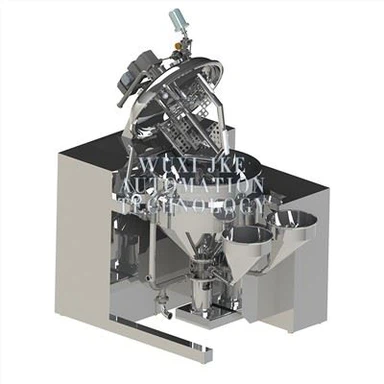


The manufacturer teaches you how to choose the emulsifying machine
Apr 08, 2022
Emulsifier plays an important role in the mixing system of industrial equipment, especially in liquid-liquid mixing, solid-liquid mixing, dispersion homogenization, oil-water emulsification, shearing and grinding.
At present, the application of emulsifier is not limited to "emulsification". Due to its grinding and shearing action, the powder particles are crushed and impacted in the liquid, and then refined to the ideal particle size, so that the solid substances are fully mixed into the liquid to form a relatively stable suspension. This process is also known as "dispersion". Therefore, the emulsifier is also known as: high shear emulsifier, high shear homogenizer, high shear dispersed emulsifier, high shear homogeneous emulsifier, high shear homogeneous dispersed emulsifier, etc.
The shearing action of emulsifier directly affects the fineness. After analysis, it is mainly related to the sharpness, hardness, dynamic and static clearance of the blade, the relative movement speed of the two cutting edges and the allowable particle size. Generally speaking, clarity, hardness, rotor clearance and allowable cutting edge particle size are basically fixed, or do not want to change the relative moving speed is a major factor, which is expressed as the circumferential linear speed of the rotor. When the linear velocity is high, the cutting density or impact density of radial flow fluid is high, and the thinning effect is stronger, and vice versa. However, the higher the linear speed, the better. When it reaches a high value, it tends to stop flowing. Therefore, the flow becomes smaller and the calorific value is high. Some substances will gather in order and the results are unsatisfactory.
Is the mixing speed shear speed? The velocity is divided into angular velocity and linear velocity. Of course, the shear velocity refers to the linear velocity, and the linear velocity = angular velocity × diameter × π。 Therefore, why is the speed of industrial emulsifiers usually only 2900 rpm or 1440 rpm, while the speed of laboratory emulsifiers is 12000 rpm or 1440 rpm at 280000 RPM. Considering the diameter factor, the cutting line speed and effect of the two are similar.