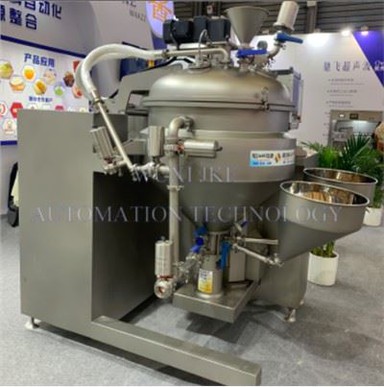


The function of a mixing tank
Jul 10, 2024
Stirring tank, as a widely used equipment in multiple industries such as food processing, chemical industry, and pharmaceuticals, its main functions are reflected in the following aspects:
Uniform mixing: The most basic and important function of a stirring tank is to fully mix materials of different components and densities, ensuring that each component is evenly distributed in the tank and achieving the expected mixing effect. This is crucial for improving product quality, ensuring product consistency and stability.
Promoting reaction: In processes that require chemical reactions or biological fermentation, the stirring effect of the stirring tank can accelerate the contact and collision between reactants, improve the reaction rate, and make the reaction more complete and efficient. Meanwhile, by adjusting parameters such as stirring speed and temperature, the reaction process can be precisely controlled and reaction conditions optimized.

Dissolution and dispersion: For processes that require the dissolution of solids in liquids or the uniform dispersion of small particles in liquids, the stirring tank can accelerate the dissolution and dispersion process through its powerful stirring ability, ensuring that the material reaches a uniform dispersion state in the solution.
Heating and cooling: Many mixing tanks are also equipped with heating and cooling systems, which evenly heat or cool the materials in the tank through stirring, ensuring the accuracy and uniformity of temperature control. This is particularly important for reactions or production processes that require strict temperature control.
Evaporation and concentration: In the food processing or chemical industry, stirring tanks are sometimes used to evaporate some solvents or water to achieve concentration. The stirring effect helps to accelerate the evaporation rate, improve the concentration efficiency, and prevent the material from coking or local overheating at the bottom of the tank.
Improving material fluidity: For materials with high viscosity, the stirring effect of the stirring tank can improve their fluidity, making the materials easier to transport and handle. This is of great significance for improving production efficiency, reducing energy consumption, and reducing equipment wear.
Promoting gas exchange: In biological processes such as fermentation, the stirring effect of the stirring tank can also promote the exchange and distribution of gases (such as oxygen, carbon dioxide, etc.) in the material, providing necessary growth environment for microorganisms, improving fermentation efficiency and product quality.
In summary, the mixing tank plays a crucial role in industrial production, and its multiple functions and flexibility make it one of the indispensable equipment in many industries